AI Adoption · July 4, 2026 · 6 min de lecture
Most teams don't have an AI tool problem. They have a Monday morning problem.
The tools are there, the adoption isn't. Eight short workshops in a free PDF to get your teams trying, comparing and walking away with something concrete.
An AI Kit for your SME
You gave everyone access to Claude. You may have even paid for the 10 licenses. And yet, on Monday morning, AI stays tucked away in a corner. A few people use it quietly, most hesitate, and nobody really knows what the team next door is doing with it.
This is not a technology problem. It is an adoption problem. The tools are already there. What is missing is a simple frame that lets people try, compare, doubt, and walk away with something concrete to test.
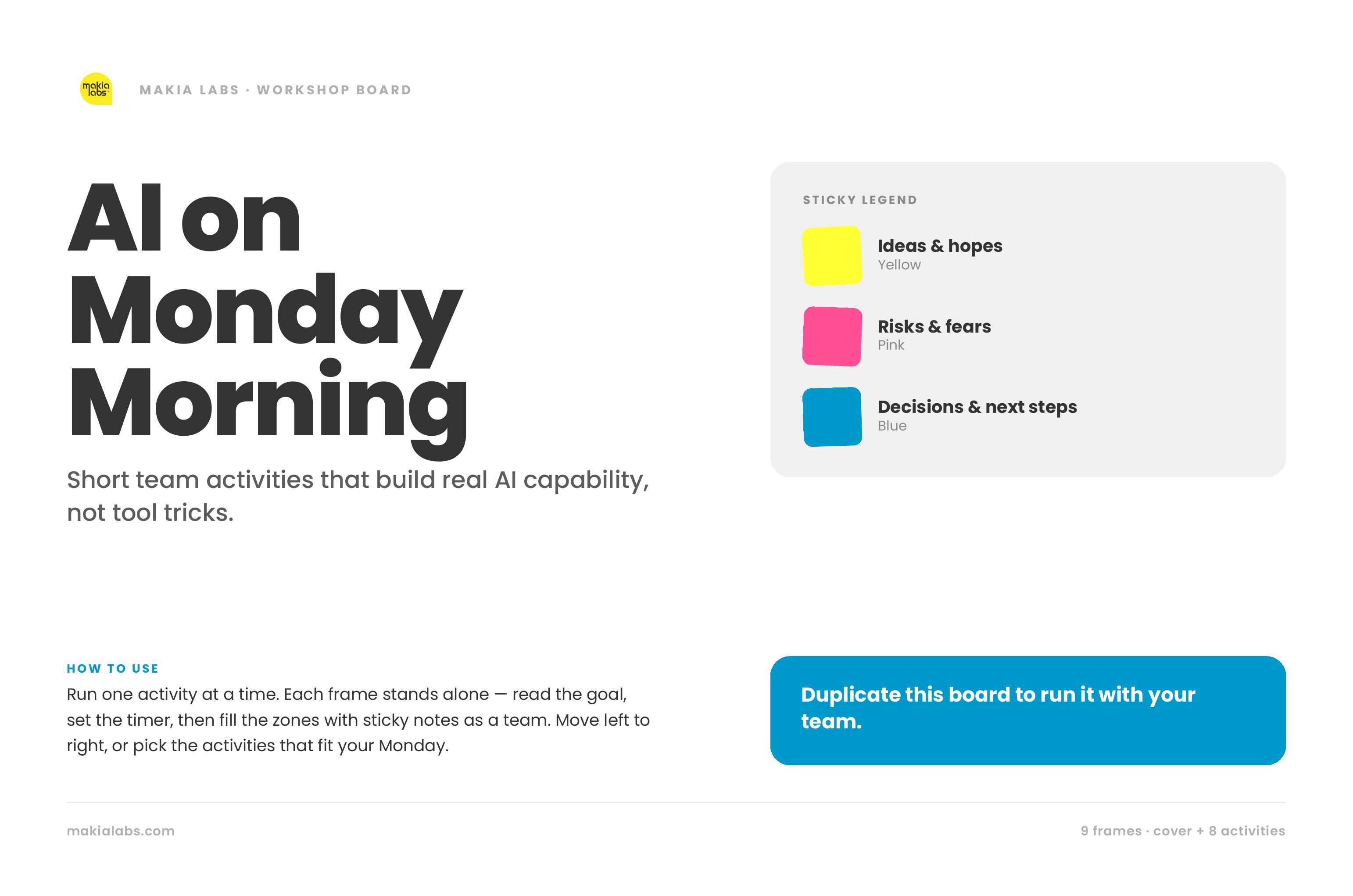
That is exactly why we built AI on Monday Morning, a team activity board we are giving away for free. No tool demo. No two hour webinar. Eight short, standalone workshops that any manager can run on a Monday morning with their team, without being an expert.
Why a board, and not one more training
Most AI content does one thing: it shows tricks. Twenty magic prompts, ten extensions to install, this week's shiny new feature. It is fun, it travels well on LinkedIn, and it changes nothing about how your team works the following Monday.
At MAKIA Labs, we start from a simple conviction: productivity is the smallest AI opportunity. If your teams only shave ten minutes off an email, they are missing the point. AI becomes genuinely useful when it helps people think, decide, catch an error, and clarify what should stay human.
You do not build those reflexes by watching a presentation. You build them by doing, together, on real work. The board follows our MAKIA framework: each activity strengthens a specific dimension, from Meaning to Actors, through Knowledge, Impact and Alignment.
How it works
The principle fits in one sentence: one activity at a time. You download the PDF, you pick the page that fits your Monday, you set the timer, and the team fills the zones with sticky notes. Yellow for ideas and hopes, pink for risks and fears, blue for decisions and next steps.
Every activity stands alone. You can run just one over a lunch break, or chain three of them for a proper workshop. None of them needs heavy preparation. Here is what the board contains.
01. The One Task (20 min)
Find the single task your team would most love to hand off, then check what AI actually did with it. Everyone writes a task they would gladly drop on a sticky, you choose one together, and you test it. The result lands in three buckets: AI helped, partly helped, or did not help. It is blunt, and that is precisely the value. You stop fantasizing about what AI could do, and look at what it does.
02. Prompt Battle (20 min)
Two prompts, the same task, side by side. You run them, compare the results, and above all write down what made the difference. This is the activity that teaches prompting fastest, because nobody theorizes: you see, live, why one wording beats the other. Your people leave with an instinct no prompt list could ever give them.
03. Spot the Flaw (15 min)
Take one confident looking AI output and hunt for what is wrong, missing, or quietly risky. The real question sits at the bottom of the frame: would we have caught this if we were busy? That is where critical thinking gets built. A team that can spot the flaws in an output is a team that can use AI without getting caught out.
04. Hopes and Fears (25 min)
Before AI truly lands on everyone's desk, surface what people quietly hope for and what they just as quietly worry about. Hopes on one side, fears on the other, then cluster the themes and note what would help each person feel in control. Fear blocks innovation far more than technology does. This activity puts the unspoken on the table, which is often the real trigger for adoption.
05. Where AI Does Not Belong (20 min)
As a team, draw the line: where AI can lead, where it assists while a human decides, and where it stays out entirely. There is even space for the edge cases you argued about, and a box for the data that should never go into an AI tool. It is a governance conversation, but run in a concrete, operational way, not in an abstract committee.
06. Steal This Workflow (20 min)
Each person shares one real thing AI helped them do this week. Who, what, with which tool, and above all: what I will try myself. In twenty minutes, everyone walks away with at least one concrete idea borrowed from a colleague. You also park the problems no one has solved yet, which naturally becomes a roadmap for what comes next.
07. The Ten Minute Experiment (25 min)
Pick a real deliverable, give AI ten minutes on it, then separate what is usable from what still needs a human. The time constraint is deliberate: it forces the team to judge quickly and without indulgence. At the end, one question: do we use this again? And if so, where. This is experimentation, not perfection.
08. The Augmentation Test (25 min)
Sort the work into two columns: what AI can take off your plate, and what must stay human. Judgment, relationships, decisions, accountability. Then, the step everyone forgets: name what that freed up time lets you do more of. Because AI does not replace human value, it moves it. And you still have to decide where.
What your teams actually walk away with
Look at the logic of the whole set. You start by confronting AI with reality (activities 1 to 3), you deal with people and fears (4), you set the frame and the limits (5), you circulate practices (6), you test on something concrete (7), and you close on the deeper question: what stays ours (8).
This is not a collection of tricks. It is a path that builds capability: confidence, critical thinking, shared language, and shared decisions. Exactly what is missing when an organization has the tools but not the adoption.
Take the kit, it's free
The AI on Monday Morning kit is a free PDF. You download it, print it or open it on a shared screen, and run it with your team as early as next Monday. No heavy signup, no strings attached.
Download the PDF (AI on Monday Morning)
If you try it, tell us what worked and what got stuck. That is exactly the kind of feedback that feeds our work at MAKIA Labs. And if you want to go further, to turn these workshops into a real adoption strategy for your organization, that is exactly what we do.
One question to leave you with: what is the first task your team would gladly hand off on a Monday morning?
MAKIA Labs · hello@makialabs.com · makialabs.com · @makialabs