AI Adoption · August 5, 2026 · 6 min de lecture
AI on Monday Morning: why we built a 55-card deck instead of yet another AI workshop
Teams leave convinced on Thursday, and nothing has moved by Monday. Here's why we turned our workshop framework into 55 cards — and how to run it yourself.
There's a precise moment in almost every engagement when we know the training alone won't be enough. It's Thursday afternoon. The team understands how a prompt works, has seen what Claude does with a meeting transcript, has tested NotebookLM on its own documents. Everyone is convinced.
And by Monday morning, nothing has moved.
This isn't a tool-knowledge problem. It's a collective-decision problem: nobody picked one use case, nobody was named owner, no date was set. The conviction evaporates because it was never written down anywhere.
What we built
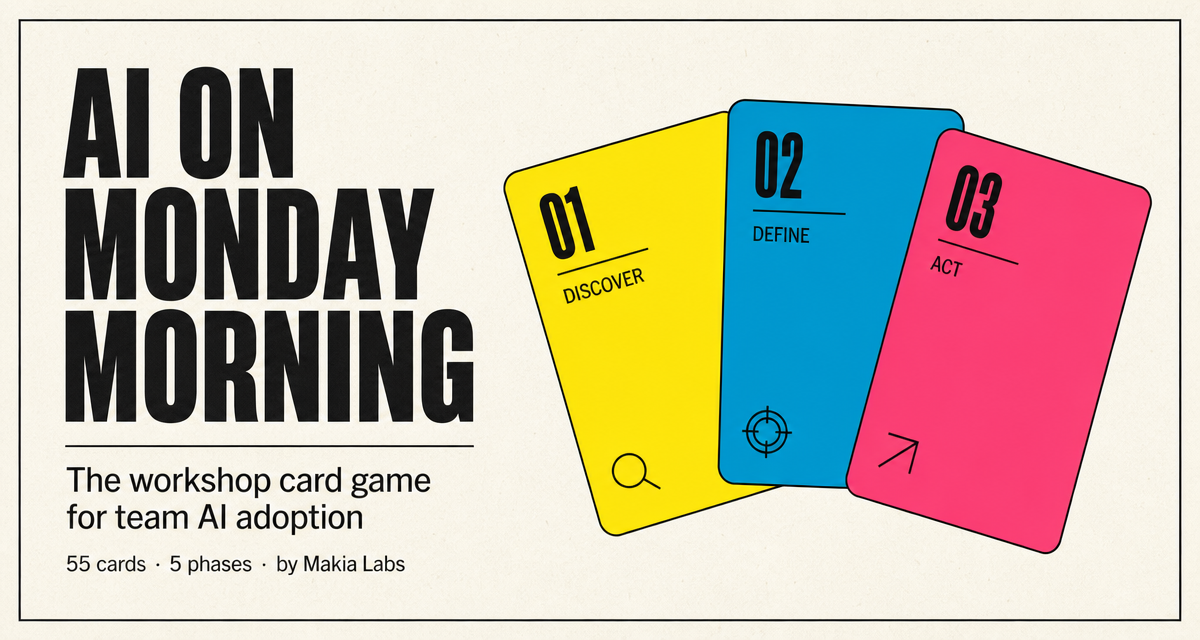
AI on Monday Morning is a facilitated workshop of 55 cards, split across 5 dimensions and 5 phases. You play it around a table, with no slides and no consultant required in the room. Flip cards, answer concrete questions about your own work, and leave with a dated plan.
Three formats, depending on the time you actually have:
- Quick Sprint — 60 minutes. 1–2 dimensions, 2 phases, roughly 3 cards each. For a team meeting already in the calendar and a single question to settle.
- Standard Workshop — 2.5 hours. All 5 dimensions, 5 phases, roughly 5 cards each. The default format: you leave with a plan and named owners.
- Deep Dive — half a day. Full dimension work, roughly 9 cards per phase. For a leadership team arbitrating a whole portfolio of use cases.
Why cards, and not a document
A document gets read alone, filed away, and forces nobody to speak. A card on the table forces an answer out loud, in front of the others, now. The format constrains the pace: each phase carries its own cards and timing, which keeps the meeting from drifting into the usual conversation about "AI in general".
The five dimensions follow the logic of the MAKIA framework we use in the field: what real problem are we solving, who will use it and who decides, what data and what expertise, how do we measure the value created, and is it aligned with the culture and GDPR. The same filter, put on a table instead of delivered in a report.
We'd rather find one use case that saves 30 minutes a day than show ten slides about the singularity.
A product built with the people who run it
It's Makia Labs' first product, and it's built to change. Every session reported back to us makes us add a card, rewrite another, drop a third because it consistently falls flat. The cards that work best today came from teams who ran the deck without us.
If you facilitate a session: tell us what landed, where the conversation stalled, and which card you skipped. That's what shapes the next deck.
How to start
The deck is free to use at aionmondaymorning.com. We also keep a page detailing the formats and the run-through: the 55-card workshop.
If the workshop surfaces more than the team can handle, the AI maturity self-assessment takes five minutes and returns a score per dimension. And if you'd rather have the first session facilitated, write to us — 30 minutes, no slides, we look at one of your use cases.